
How should education settings identify special educational needs?
The SEND Code of Practice 2015 says that nurseries, schools, and colleges should spot special educational needs (SEN) as early as possible. They should do their best to give children and young people the right support so they can learn well and achieve the best possible outcomes.
When a school or setting identifies that a child has SEN, it should record this and let parents know. The setting should also explain what extra support it is providing to help meet the child’s needs.
Useful Links
What is a Special Educational Needs Coordinator ?
Every mainstream nursery, school, and college must have a Special Educational Needs Coordinator (SENCO).
The SENCO is a qualified teacher who helps make sure children and young people with special educational needs get the support they need. They must either have the National Award for SEN Coordinators or be working towards it.
The SENCO should make sure parents and carers know what extra help their child is receiving. They should also keep records of the support given and how well the child is progressing.
The role of the SENCO: what do you need to know? - Special Needs Jungle
What is a Special Educational Needs Coordinator (SENCo)? | Twinkl Teaching
What should nurseries, schools and colleges do to support children or young people with special educational needs?
All education settings have a duty under the Equality Act 2010 to make reasonable adjustments to provide support for a child or young person’s special educational needs.
Examples of reasonable adjustments include:
- Using visual aids, pictures, and reminders.
- Giving extra time to complete tasks.
- Providing technology such as laptops, iPads, or reading pens.
- Teaching key ideas before a lesson or going over learning again.
- Working in a small group or receiving extra support from a teacher.
Schools and colleges should ask for specialist advice when needed. This may involve getting help from professionals such as a speech and language therapist or an occupational therapist.
The ‘best endeavours’ duty | (IPSEA) Independent Provider of Special Education Advice
North Yorkshire Council have SEND Hubs
These hubs have experts who help with the four main areas of SEND:
- Communication and Interaction
- Cognition and Learning
- Social, Emotional and Mental Health
- Sensory and Physical Needs
Nurseries, schools, academies, and colleges in North Yorkshire can ask the SEND Hub for advice. Education settings outside North Yorkshire can also make a referral if they support a child or young person who lives in North Yorkshire.
SEND hubs | North Yorkshire Council
SEND hubs | CYPSinfo (northyorks.gov.uk)
See our Useful Links section to find further information.
What is the graduated approach?
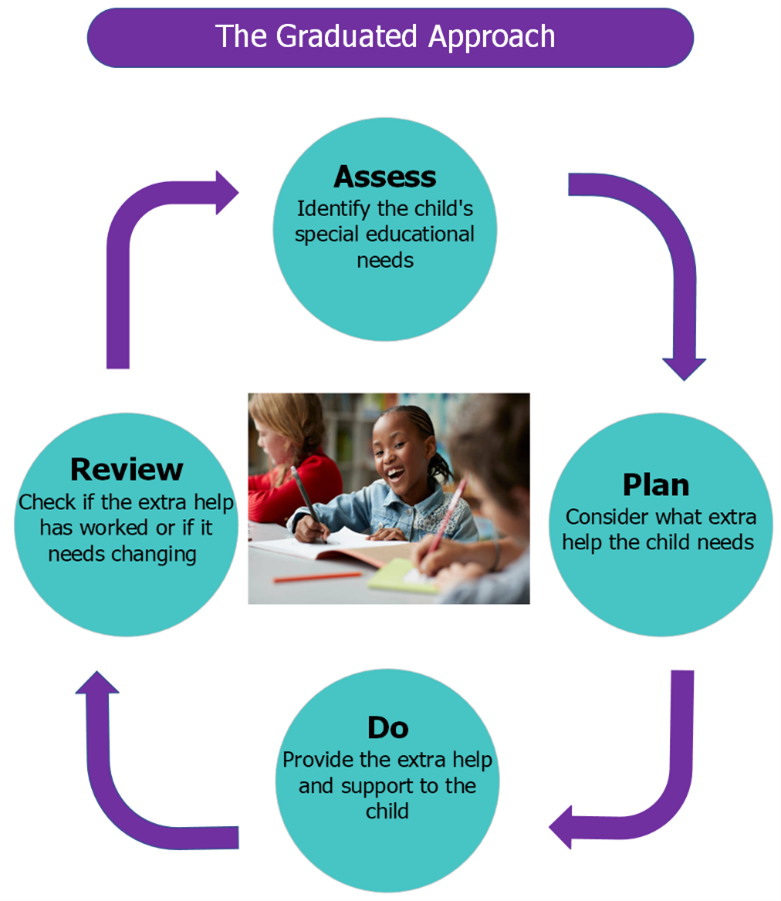
Nurseries, schools, and colleges should use a graduated approach to plan and review support for children and young people with SEND. This is a simple four-step process that can be repeated as often as needed to help a child make progress.
The steps are:
- Assess – Find out what the child or young person needs help with.
- Plan – Decide what extra support or help will be provided.
- Do – Put the support in place.
- Review – Check whether the support is helping. If needed, make changes and try different support.
By following these steps, education settings can make sure children and young people get the right help at the right time.
What is a SEN support plan?
If your child or young person is getting SEN support, the school should create a SEN support plan with you and your child.
The plan should:
- Focus on what your child wants and needs to achieve.
- Set clear goals for your child.
- Explain what support the school will provide.
- Show how the support will help your child make progress.
Different schools may use different names for SEN support plans. You may hear them called:
- My Plan
- One Plan
- Individual Education Plan (IEP)
- Pupil Support Plan
- Provision Map
Whatever it is called, the plan should clearly explain your child’s needs, the support they will receive, and the goals they are working towards.
Special Educational Needs (SEN) support | North Yorkshire Council
SEN Support | (IPSEA) Independent Provider of Special Education Advice
About Special Educational Needs and Disabilities (SEND) | North Yorkshire Council
See our Where can I find out more about SEND Support section to find further information
How should school work with me to support my child/young person with SEND?
Nurseries, schools, academies, and colleges should work closely with parents and carers to support children and young people with special educational needs (SEN).
- Nurseries should involve parents in decisions about the support their child receives.
- Schools should meet with parents at least three times a year to talk about their child’s SEN and the progress they are making. Schools should also provide a report each year on the child’s progress.
- Colleges should involve students in decisions about their SEN support. For students aged 16–18, parents should also be included where appropriate.
Working together helps everyone understand a child or young person’s needs and make sure they receive the right support to achieve their goals.
Nurseries (5.37 SEND Code of Practice 2015)
Schools (6.64/6.65 SEND Code of Practice 2015)
Colleges.8.13/8.17 SEND Code of Practice 2015)
See our Where can I find out more about SEND Support section to find further information.
What can I do if I am worried my child/young person is not getting the support they need in nursery/school or college?
If you are worried that your child or young person is not getting the help they need at nursery, school, or college, it is a good idea to talk to the setting.
You could speak with:
- Your child’s teacher or key worker.
- The Special Educational Needs Coordinator (SENCO).
- The Headteacher or Principal.
Talking to the setting can help you understand what support is in place and discuss any concerns you may have.
The leaflets and links below may help you prepare for a meeting and think about the questions you would like to ask.
SEN Support Questions To Ask At A Meeting
Working With Your Child's School - Autism Education Trust
If after speaking with school/college, you are still unhappy about the support your child/young person is getting please visit our section on Making a Complaint - Education Complaint
See our Where can I find out more about SEND Support section to find further information.